Powered By Blogger
Showing posts with label Mendocino. Show all posts

Tuesday, August 23, 2011

Abalone Diving

Click on ALL photos for more detail
 For over thirty years, my husband and a band of friends have been making trips to Mendocino to dive for abalone.  Abalone are sea snails that live underwater, attach themselves to the undersides of rock edges with their single suction-cup foot and graze on the kelp growing in the ocean. They are hunted avidly by divers. The taste of abalone is hard to describe. Not fishy in the least, it is tender and almost a cross between the taste of lobster and crab meat. It is simply delicious.  To legally harvest this delicacy (you cannot buy wild abalone and farmed abalone sells for about $100 per pound) the hunters must ‘free-dive’ meaning no oxygen tanks or oxygen hoses can be used. This limits the depth to which a hunter can go, and it limits how long he/she can stay underwater. Supposedly these restrictions give the abalone a fairer chance. 
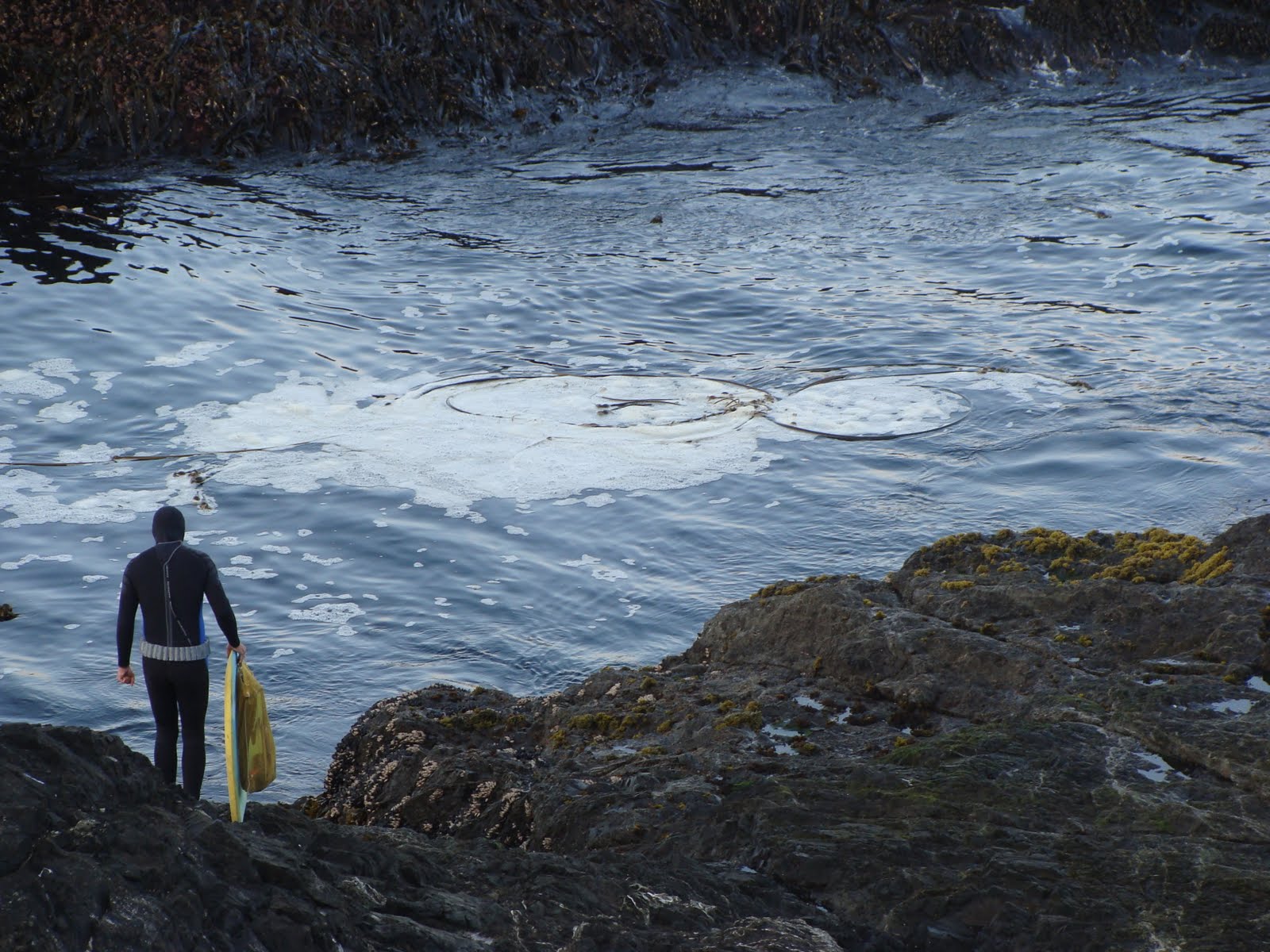
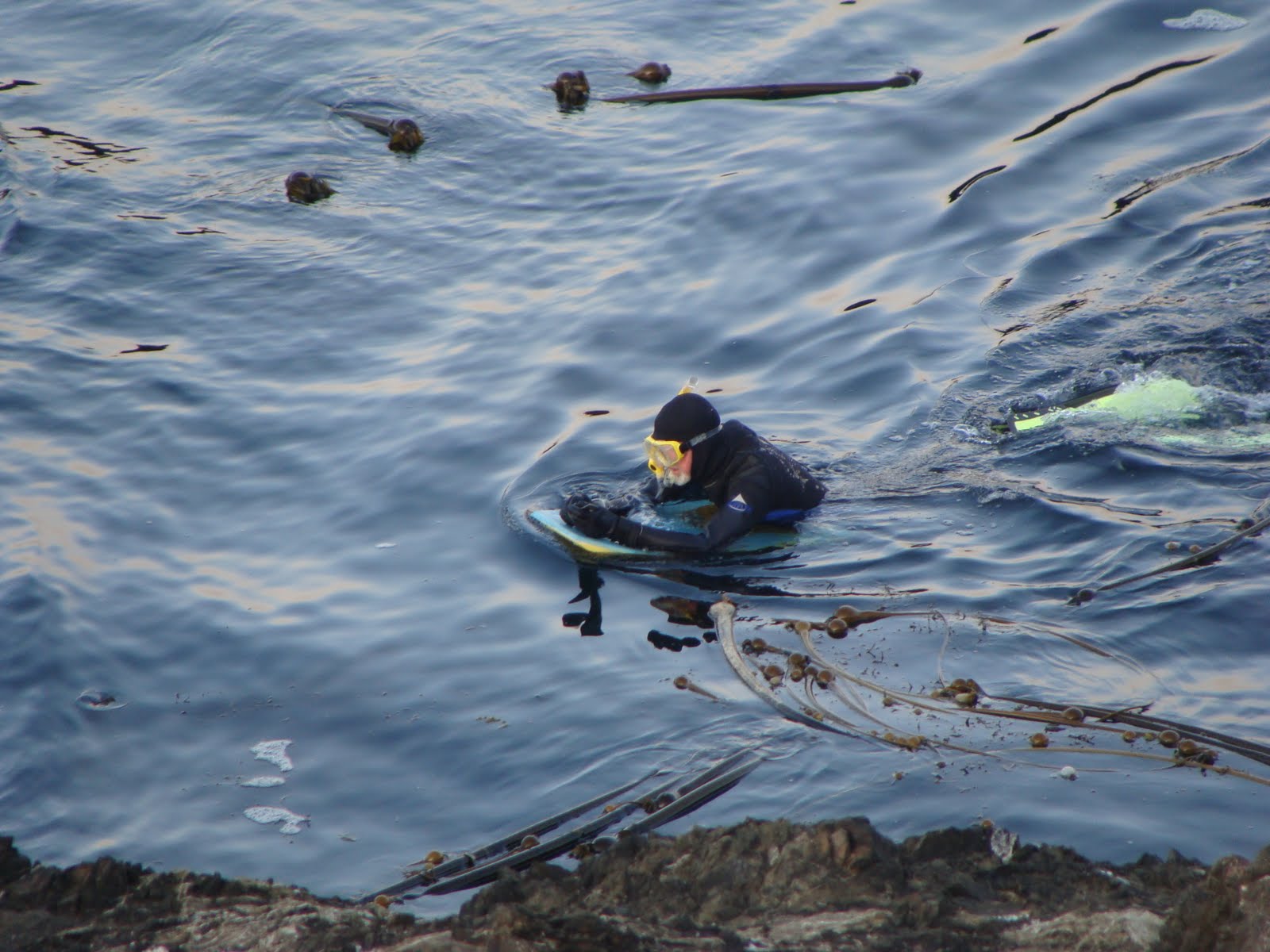
Legal sized (seven inches) abalone can be found at any depth, but the larger ones are usually deeper and hidden in crevices.  My husband can dive to about 25 feet, but is much happier when he can get good ones at 12-15 feet.  Abalone hunters wear thick rubber wetsuits because the ocean in Northern California is very cold (50 degrees F/11 degrees C).  The wetsuit my husband wears to surf is not thick enough to keep him warm for an abalone hunt. These hunters also use snorkel masks, weight belts and fins, and have their 'ditty' bag attached to a float board. The ditty bag is useful in hauling their equipment when they descend or ascend the cliffs, and it is useful to haul their catch! Three legal-sized abalone would be very awkward to carry (they are round with no handles!) and are heavy (about ten pounds altogether). The ditty bag also carries the tags and ties that are required to legally take abalone out of the ocean. The heft of the weight belt is determined by the diver's body weight. The heavier the diver, the more lead weights on his belt to help him stay underwater. Most divers in their prime can dive for one minute, but it is more comfortable to remain under for only 30 seconds. Try holding your breath for one minute, and imagine swimming and prying a reluctant critter off a rock at 20 feet at the same time. Not easy to do.
Divers/hunters are limited to three abalone a day and a total of twenty-four  per year. Divers can only hunt for abalone in certain months of the year, and the shell must be a minimum of seven inches across for the abalone to be mature enough to harvest. Divers carry small ‘ab irons’ that resemble tire irons and these are what they use to pry the abalone off the rocks. It costs nearly $75 to get a license for abalone. The rangers sit on the cliffs and watch through binoculars. If they suspect someone has too many abalone or is not tagging them properly on the beach, the rangers swoop down and write tickets with enormous price tags. About three years ago, the first year with the 'new' tag system, my husband freely admitted to the ranger that he had not tagged his abalone properly because he did not have scissors with him at the beach. The ranger ticketed him on the spot at the campsite and it cost $500.
Abalone meat is delicious to eat, and the shells are beautiful to display. The diving, I am told, is fun as long as you don’t get caught in the kelp or lose your weight belt or see a large creature with a single fin eyeing you like you are going to be its lunch. The ocean must be very calm and the tide must be out for optimal abalone diving.


Swimming in the heavy kelp
 When I first moved to California, this is one trip my husband could hardly wait for me to make with him. Off to Mendocino to camp in a tent for four days in Van Damme State Park, his diving friends and their families camped around us. I enjoyed the whole event. Definite selling points for me included the potluck feasts every night with the main entrĂ©e being abalone,  the side dishes that were family specialities and the big 'family reunion' atmosphere. Long evening sessions around the campfire with my husband and his friends playing their guitars and singing campfire songs were so entertaining. The visiting and bouts of laughter were cherished. The physical contentment that comes from days spent outdoors led to deep restorative sleeps in our sleeping bags in our tents.  The camaraderie of the band of abalone hunters was seamless, woven tightly after many consecutive years and strong enough to have survived these many years. The members of this band were newly-weds together, young teachers together and new parents together. They observed the growing up of each other’s kids and the growing old of each other.
Coming in, giving me the all's-good wave!
An abalone as it comes from the ocean
The annual Mendocino camping/diving trip seems to be on its last legs. The group used to number in the forties for the potluck dinners, and whole sections of  Van Damme State Park were crammed with our tents, trailers and RVs. No more. Last year there were only two families in our section of the park, and only about ten of us for dinner each night. There were two other families from the original group in another part of the campground but beyond some socializing, there was not a lot of contact. Most of the original abalone divers have 'retired' due to their age or health conditions. My husband and maybe one or two others of the original hunters still dive. The next generation (with the exception of a very few who were raised with annual camping/diving trips) seems to be more interested in other recreational pursuits. It is sad to see this 30-year-old tradition end.  I shall miss the campfires, singing, shared potluck meals and hours of visiting in the afternoon sunshine.  I know my husband is mourning this loss of the time together with his friends in the water and woods.
 

Abalone shells emptied of their meat with an ab iron resting on them


Monday, August 15, 2011

Away to Mendo


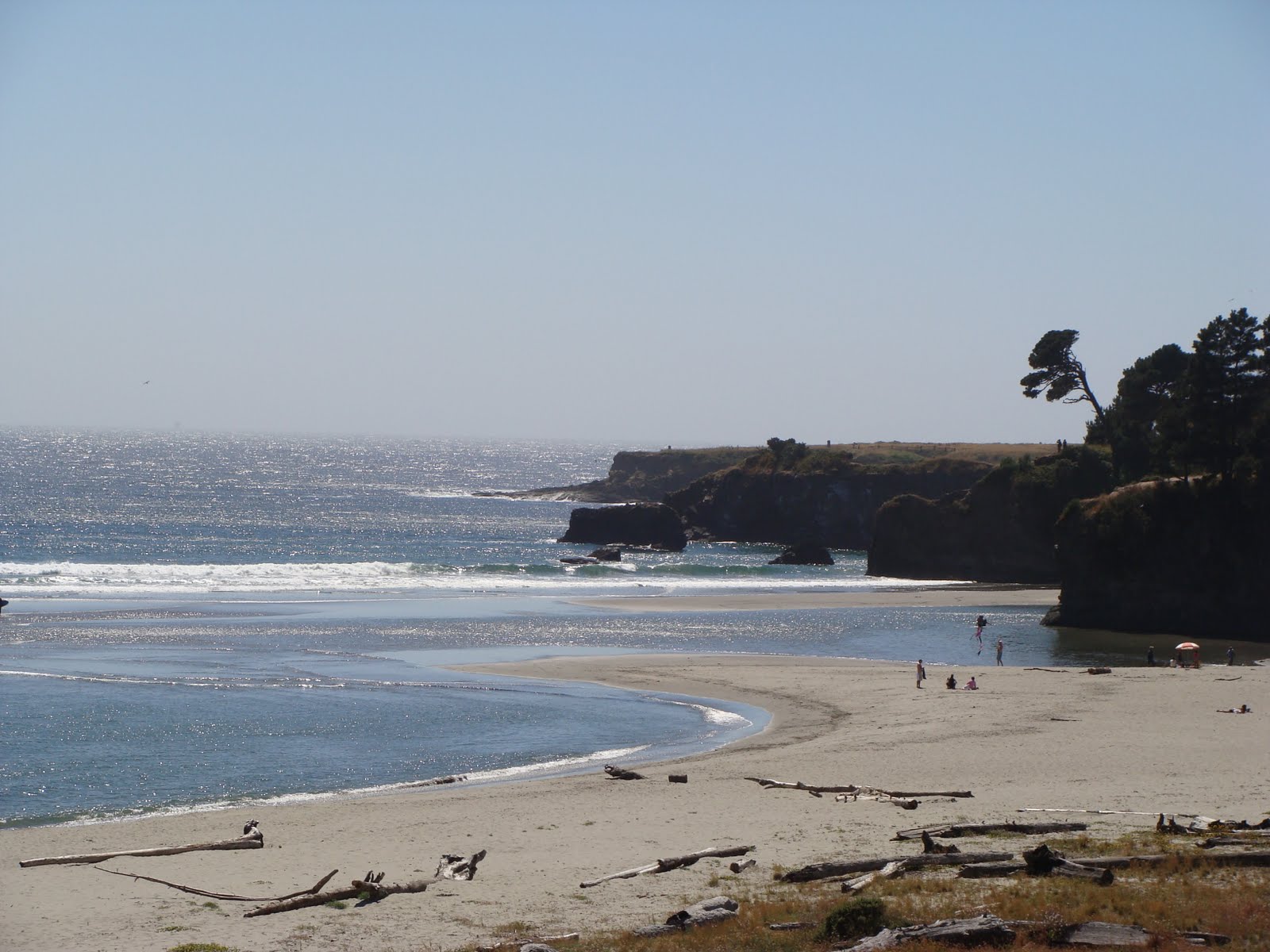
Where the river meets the ocean below the village of Mendocino
 And away to Mendocino we go again. Along California’s northern coast, this is a place that my husband and I visit at least twice a year. We pack our overnight bags, our dog and my husband’s dive gear and off we go. The trip easily takes five or six hours from our house in Santa Cruz (it is almost two hundred miles) and it is not a fun drive. It takes at least thirty minutes to get to San Jose over the coast mountains via the dreaded accident-studded Highway 17.  Onward to San Francisco, through San Francisco and across the Golden Gate Bridge, and then through the heavy traffic of Santa Rosa.


Golden Gate Bridge
The mercury in the thermometer begins to seriously rise and by the time we get to Cloverdale, it is often 95 degrees (35 Celsius), a huge difference from the 65 degree temperature (18 degrees Celsius) when we left Santa Cruz three hours ago. We always stop at Cloverdale and fortify ourselves with sandwiches and cold drinks for the remainder of the trip. Sometimes it is too hot for the dog’s feet to walk on the asphalt so we carry him to the graveled side yard to relieve himself. Cloverdale is the last stop on the four-lane freeway. From there to Mendocino, a one and one-half hour slow drive, there is a two lane winding up-and -down road that makes me car-sick EVERY time. My husband does not suffer from car-sickness. Neither does the dog. I suffer alone. Usually as we crest that last hill and twist through that last turn, and finally see the ocean again, I have a gut-ache, a head-ache and a severe lack of cheerfulness. And still I come at least twice a year.


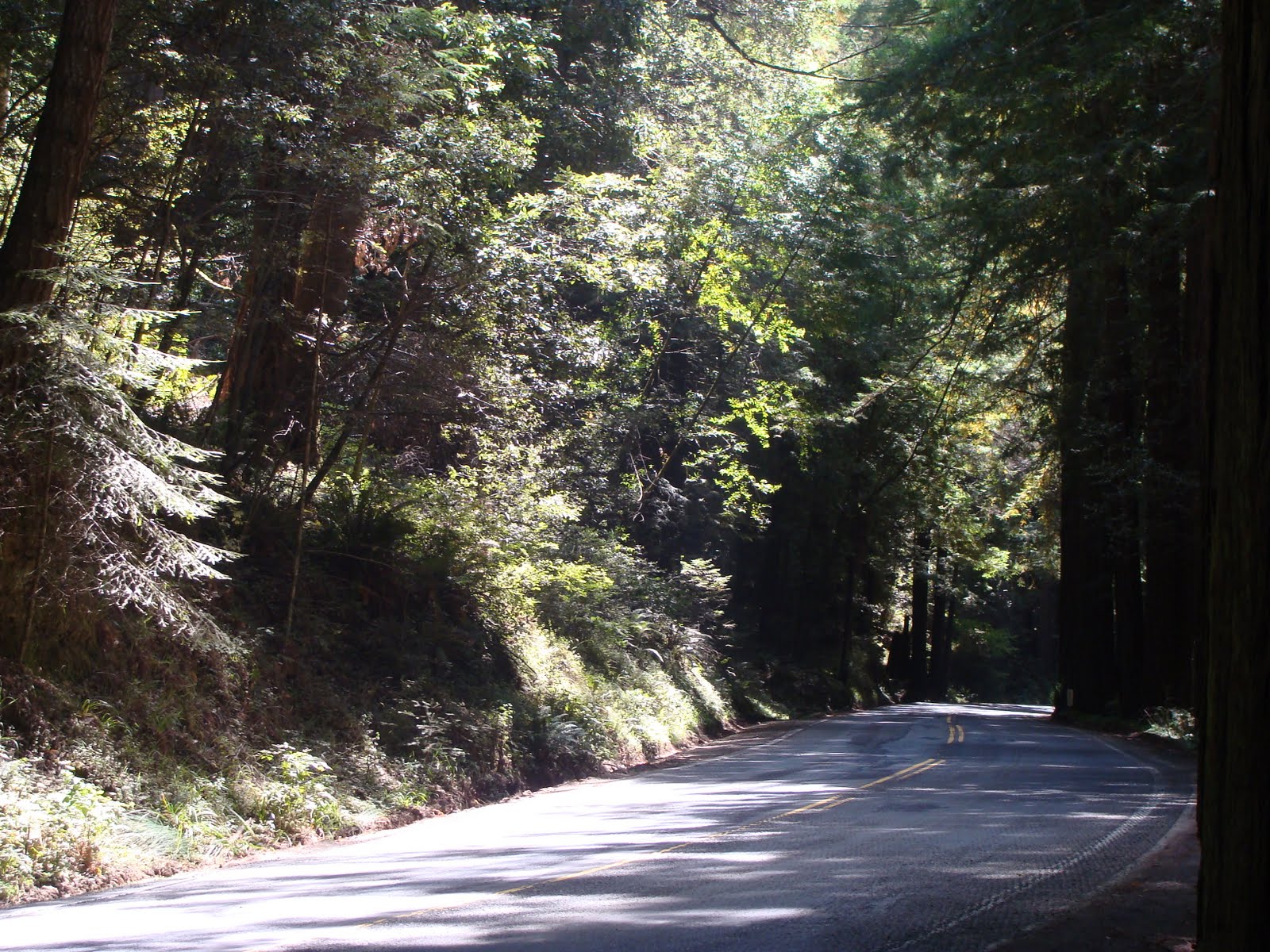
Winding road

Coastal redwoods

Why do I willingly submit to a horrific bout of car-sickness at least twice a year? Obviously Mendocino is a magnet for me. Lest you question my intelligence, let me tell you that I am not the only one affected by the pull of this area. Thousands of visitors from all over the world make their way to this quaint village by the sea every year. Originally settled by loggers lusting after the huge redwoods, Mendocino was created in the middle of the nineteenth century. The big redwoods were cut, milled and loaded into ocean-going freighters. Trucks replaced ships, logging became more regulated and the logging industry required fewer workers. Mendocino went into a slump. In the 1950’s, it resembled a ghost town. Enter Bill Zacha, a multitalented high school teacher from the San Francisco Bay area who envisioned an artists’ haven. He began to rebuild Mendocino. He bought run-down properties for as little as fifty dollars down, and spruced them up to attract renters and businesses. It worked. The picturesque houses and commercial buildings remained standing. Artists began to settle in the town and the surrounding area. Mendocino attracted several big movie productions with it pristine appearance and willingness to work with the film companies. Some of the two dozen or more movies shot here include: "East of Eden", "Island of the Blue Dolphins", "The Summer of '42",  "Cujo", "Overboard", "Wired" and "Karate Kid III". The long-running TV mystery, "Murder She Wrote" with Angela Lansbury was also filmed in Mendocino.

Tourists began to make the drive to see the location where their favorite films had been made, to see the quaint Victorian houses on the bluffs overlooking the Pacific, to walk on the headlands surrounding the town and make their own discoveries in the art galleries and unique shops of the main streets. My husband and his friends have been coming to Mendocino for over thirty years to camp and dive for abalone, a delectable sea snail that lives underwater. When I accompanied my husband and his friends on a June camping and diving trip many years ago I received my first introduction to Mendocino. I can proclaim that it was love at first sight!

Flower garden in the village
Mendocino is the most beautiful place on earth. Easy for a prairie girl from Saskatchewan to say, right? Well, since my very first trip years ago to Mendocino, I have been to a few other places. I spent two weeks in Scotland (gorgeous), ten days in London (interesting but not beautiful), a week in Hawaii (nice but not stunning) and two weeks in Spain (another gorgeous place). None of those locations can unseat Mendocino in my personal (and biased) hierarchy of beautiful places. The picturesque houses, the high wooden sidewalk, the blooming flowers everywhere, the cleanliness of the town and roads, the view from the main street out to the ocean and backed by redwoods, the sheer dramatic drop from the cliff tops to the ocean, the rattlesnake grass blending into the flowing golden grasses on the headlands moving in the chilly salty air all add up to a splendor I have not witnessed anywhere else I have been.

The headlands: rattlesnake grass in the foreground
Click for more detail
Perhaps the isolation of the town and the tininess of the town remind me of my childhood in Saskatchewan. Perhaps the long view to the horizon on the Headlands and the waves of golden grass also remind me of the Prairies where I grew up. Perhaps it goes back even farther. Perhaps, because of my Scottish lineage, and the resemblance of Mendocino to Scotland’s coast, there exists in my very genetic material, in my DNA, an inherited attraction to the scenery of Mendocino. 

 
Village of Mendocino
Today Mendocino is a village of less than 900 residents. It is possible that its population triples during the day when visitors crowd into its shops, galleries and restaurants and remains double at night when all the beds in the bed-and-breakfasts and inns are tucked up with sleeping travellers. You can eat fish and chips in a family-type restaurant, or duck breast in a tres French restaurant.You can buy almost anything there from groceries to art works to estate jewelry to hemp clothing to homemade jams to books and so on and so on.  The coffee shop just off the high street serves a diverse group. Dreadlocked men and women in ragged hippie clothing sit side by side with very proper tourists from England, young parents try to chug their lattes while they rock the designer strollers their fussing tots sit in, campers from the parks smell of wood smoke as they catch up on the world news in the papers and some people just sit there and simply watch the people passing through. The coffee shop is a microcosm of life in Mendocino; all kinds of people with many languages heard, different ethnicities observed and yep, some wild wardrobes displayed.

MacCallum House: our wedding planner
The strongest reason why Mendocino is such a magnet for me is very personal. The appeal of Mendocino is forever cemented in my mind by its association with a life-changing event that occurred there several years ago. On a chilly June evening, on the edge of the cliffs of Agate Cove at sunset, our wedding took place. We drove to the edge of Mendocino with a Justice of the Peace and a photographer, and at 8:00 pm, we exchanged vows with only the JP and the photographer in attendance. We were in Mendocino a day before the dive band of friends and family were to arrive. The next afternoon as the divers began to drift into camp, we told them we had married the night before. We celebrated the first days of our marriage with these dear friends in the most beautiful place on earth. This may be the main reason that keeps Mendocino in my mind as the place I have to visit at least twice a year, regardless of the car-sickness, traffic or heat. To me, Mendocino is a sacred place, sandwiched between redwoods and ocean, carpeted by golden grass, paused in time and seemingly untouched by modern cares.

Agate Cove~ our personal wedding chapel.